HMP Lowdham Grange was “fundamentally failing to fulfil its purpose” as a category B training prison, according to HM Inspectorate of Prisons. Inspectors rated it poor for safety and for respect.
The inspectorate’s report, published in June 2025, followed fieldwork that ended in March 2025. Chief Inspector of Prisons Charlie Taylor considered issuing an Urgent Notification, a formal alert to the Secretary of State. He decided against it because HM Prison and Probation Service already knew of the failings and was giving significant support.
Lowdham Grange, near Nottingham in the East Midlands, holds adult men serving long sentences, including life. Many pose a very serious risk of harm. It held 836 men during the inspection, against an operational capacity of 888.
A failed handover
Serco ran the prison from 1998 until August 2023 on a 25-year contract. Sodexo then took over. The report said leaders mismanaged the handover and the new contractor failed to deliver on its commitments. HM Prison and Probation Service took direct control in August 2024.
At the previous full inspection in May 2023, leaders were three months into that transition. Inspectors then rated safety, respect and rehabilitation and release planning not sufficiently good, and purposeful activity poor. An independent review of progress followed in early 2024, published in February 2024. Mr Taylor wrote that little had changed by then.
This time inspectors judged safety and respect poor. They rated purposeful activity, which covers education, work and time out of cell, and preparation for release not sufficiently good. Safety and respect have therefore fallen by one step. Purposeful activity has risen by one.
Of 14 concerns raised in 2023, the prison had addressed two, partly addressed three and left nine unaddressed. None of the four respect concerns had been resolved. Inspectors raised 15 key concerns this time, five of them priorities.
While there were some early signs of improvement in the provision of education, skills and work, the jail was fundamentally failing to fulfil its purpose as a category B training establishment and just 39% of surveyed prisoners told us that their experience in the prison would reduce their likelihood of reoffending.
Charlie Taylor, HM Chief Inspector of Prisons
Violence, drugs and self-harm
In the inspectorate’s survey, 40% of prisoners said they felt unsafe. Violence had risen since 2023, and use of force had trebled. Inspectors found poor governance of force, especially in the segregation unit.
Self-harm had fallen over the previous 12 months but remained the third highest among category B training prisons. It stood 39% higher than in 2023. Two prisoners had taken their own lives in the previous two years. The report said leaders had responded poorly to recommendations after deaths in custody.
Drugs were widely available. Random testing returned a positive rate of 40.6% over the previous 10 months, and 56% of prisoners surveyed said drugs were easy to obtain. Inspectors said four deaths in two years were suspected to be linked to drug misuse. Security had improved, with better work with the police and more finds of illicit items.
There had been 10 deaths in custody since the 2023 inspection, and a further death during the inspection itself.
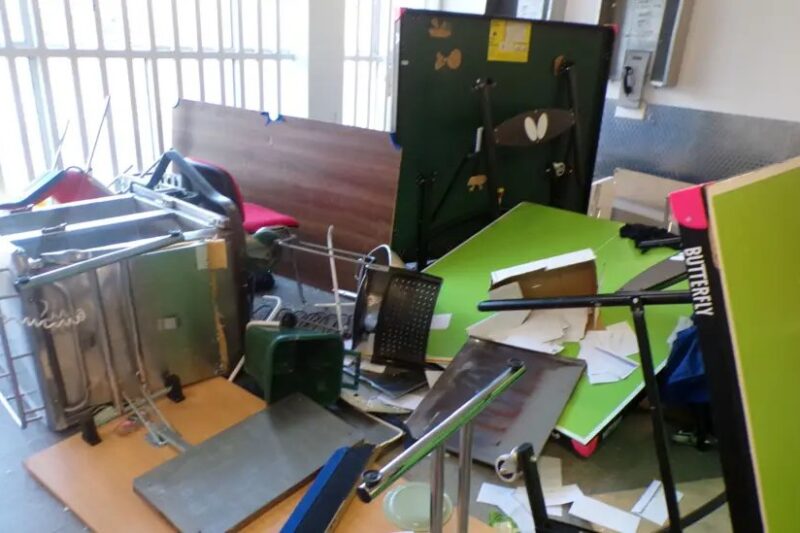
Work to reward good behaviour barely existed, and the disciplinary system was in disarray.
Inexperienced staff and unsafe health care
The prison’s main strength was its accommodation. Every prisoner had a single cell, and the prison was not overcrowded.
Relationships between staff and prisoners, however, were inadequate. Many officers were very inexperienced and poorly supervised, and middle managers lacked visibility on the wings. Prisoners could not rely on staff, and key work barely happened. Complaints systems lacked credibility. Inspectors found some disabled prisoners living in neglectful conditions.
Health services were unsafe. Mr Taylor wrote that inadequate leadership and staff shortages had produced some of the worst health care inspectors had seen in recent years. Patients faced extremely long waits for primary care.
Activity, release and signs of hope
Staff often cut the regime short or delivered it inconsistently. During roll checks, inspectors found 43% of prisoners locked in their cells during the working day. Attendance at maths and English was particularly low. Just 39% of prisoners surveyed said their time at the prison would make them less likely to reoffend.
There were early signs of improvement in education, skills and work. Inspectors praised a media course that taught industry-standard digital skills. Easy-read licence conditions with pictures helped men with learning needs.
Offender managers carried high caseloads and saw prisoners only at key events such as parole. Most men came from other areas, yet work on family ties was underdeveloped. Inspectors called the visits booking system shambolic.
A new governor had recently arrived and quickly grasped the key issues. Inspectors left “with some hope that the chaos seen at recent visits had started to subside”. Mr Taylor said she would need continued support to rebuild her senior team.
The inspectorate later published an independent review of progress at Lowdham Grange in June 2026.
About this story
This story is based on HM Inspectorate of Prisons’ report on HMP Lowdham Grange, published on 17 June 2025, following an inspection that ended in March 2025. All figures and judgements are the inspectorate’s. Read the full inspection report · See the prison’s profile in our directory.