HM Chief Inspector of Prisons Charlie Taylor used the Urgent Notification process at HMP Swaleside. Inspectors had found very high levels of violence and a lack of order and control.
Inspectors made an unannounced visit to the category B men’s prison in December 2025. Mr Taylor addressed his letter, dated 15 December 2025, to the Deputy Prime Minister at the Ministry of Justice. The inspectorate published it in December 2025.
Swaleside received the lowest grade, poor, on all four healthy prison tests. These are safety, respect, purposeful activity and preparation for release. Mr Taylor wrote that the prison had not fully addressed any of the concerns raised at the 2023 inspection.
What an Urgent Notification means
An Urgent Notification is a formal letter in which the Chief Inspector of Prisons tells the Justice Secretary about urgent and significant concerns at a prison. The Justice Secretary must respond publicly within 28 days, setting out how the concerns will be addressed.
The letter said this was the fifth time inspectors had visited Swaleside since 2016. Mr Taylor described a prison with a record of poor performance. It had scored not sufficiently good on all four tests in 2023. In earlier years it had received poor grades for safety in 2016 and for preparation for release in 2018 and 2021.
This was marginally improved by leaders during our inspection, but it remained wholly insufficient and inhumane.
Charlie Taylor, HM Chief Inspector of Prisons
Violence, drugs and drones
Very high levels of violence affected every part of prison life, the letter said. A third of prisoners told inspectors’ survey that someone had physically assaulted them. Three-quarters said they had felt unsafe.
Drug taking was rife. Drones regularly brought contraband into the jail, including knives. Many staff lacked experience and did not feel confident in challenging poor behaviour. Inspectors saw prisoners refusing searches.
Officers faced high levels of violence in their work. Many told inspectors they were burnt out and demoralised. There were few consequences for poor behaviour and few incentives for men who followed the rules.
During the inspection, the prison moved more than 20 troublesome prisoners to other jails. The National Tactical Response Group, a specialist prison service unit, had arrived temporarily with patrol dogs to help maintain order.
There had been two suicides since the previous inspection and three non-natural deaths. Recorded self-harm was consistently high. Inspectors judged the arrangements for prisoners under constant supervision unsafe.
Conditions and a restricted regime
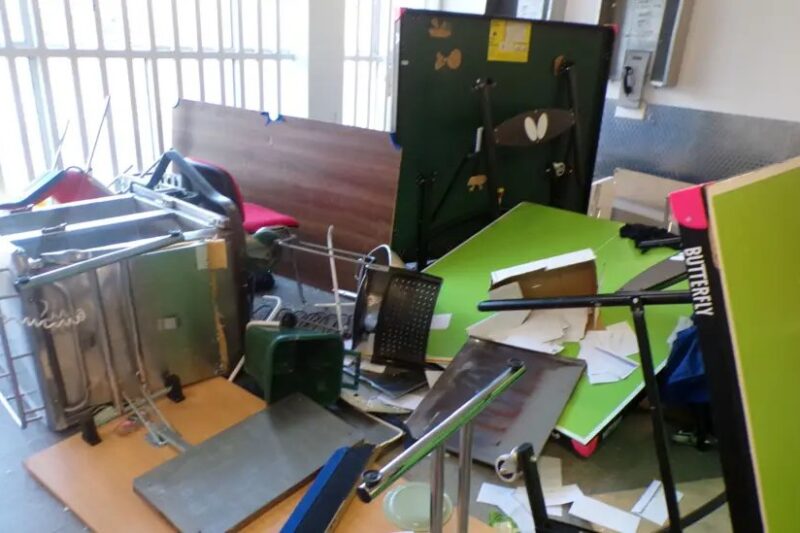
Most wings were filthy and too many cells were in poor repair. Inspectors saw widespread graffiti, fire damage, broken furniture and dilapidated flooring. Showers were dirty, mouldy and poorly maintained.
Leaders brought in a revised regime at the start of the visit, apparently to try to restore order. It severely restricted time out of cell. The published timetable allowed 44% of prisoners only 30 minutes unlocked on most weekdays.
Leaders improved this slightly during the inspection. Mr Taylor said the regime nevertheless remained “wholly insufficient and inhumane”. Leaders had not prepared staff or prisoners for the change, and anger and frustration had grown. The letter said it was unclear how the restrictions would reduce violence.
Mr Taylor said the prison was failing in its core function as a training prison. Too many men had nothing to do all day. Activities that improved employability had stopped because of HMPPS cuts to education. Many prisoners missed health care appointments, often because they feared violence.
Most men at Swaleside were assessed as presenting a high risk of serious harm to others. Even so, inspectors found serious gaps in public protection work. Screening backlogs meant the prison had failed to intercept mail or listen to the phone calls of dangerous men who needed monitoring.
Staffing, leadership and what followed
Mr Taylor said HMPPS, the prison and probation service, had failed to solve chronic staffing problems. Fewer than three-quarters of officers were available for operational duties. The prison struggled to recruit middle managers and had far too few probation staff.
He called it shameful that the prison had gone without a permanent governor for many months in 2024 and 2025. The new governor had been in post for five months and had drawn up plans. Inspectors found leaders lacked operational grip and were not visible on the wings.
Mr Taylor praised many hardworking staff for doing an impressive job in very difficult circumstances. He also wrote: “There was a pervasive sense of despair among prisoners at Swaleside, many of whom felt hopeless, helpless and afraid.”
Inspectors have reported on HMP Swaleside again since, with a full inspection published in March 2026.
About this story
This story is based on the Urgent Notification on HMP Swaleside that HM Inspectorate of Prisons published on 17 December 2025. It covers an earlier report: the prison’s profile has the latest findings. All figures and judgements are the inspectorate’s. Read the Urgent Notification · See the prison’s profile in our directory.