HMP Highpoint, a large category C training and resettlement prison in rural Suffolk, was not doing the job it existed to do. That was the central finding of HM Inspectorate of Prisons in its report on the jail, published in January 2024.
Inspectors judged purposeful activity at the prison to be poor, the lowest of four possible grades. They visited between 16 and 27 October 2023. They found a competent, orderly establishment with settled leadership. Yet too few men took part in education, training or work, and too much teaching was weak.
HM Chief Inspector of Prisons Charlie Taylor set out the problem plainly in his introduction. “Our biggest concern, however, was that the prison was not fulfilling its core purpose,” he wrote.
How inspectors graded the prison
The inspectorate assesses prisons against four healthy prison tests: safety, respect, purposeful activity and preparation for release. Purposeful activity covers education, work and time out of cell. Preparation for release covers the help people receive before they leave, including offender management and resettlement support.
At Highpoint, inspectors rated safety reasonably good and respect good. They judged purposeful activity poor and preparation for release not sufficiently good.
The picture broadly matched the previous inspection in August 2019. Inspectors then found a safe and respectful prison with a reasonable regime. It needed to do more, however, to help men progress through their sentences. By 2023, the regime and the provision of education, training and work had deteriorated.
At the time of the inspection, Highpoint held 1,284 adult men against an operational capacity of 1,308. The prison assessed almost half of them as presenting a high or very high risk of harm to others. Some 240 men were foreign nationals, and 42% came from a black and minority ethnic background.
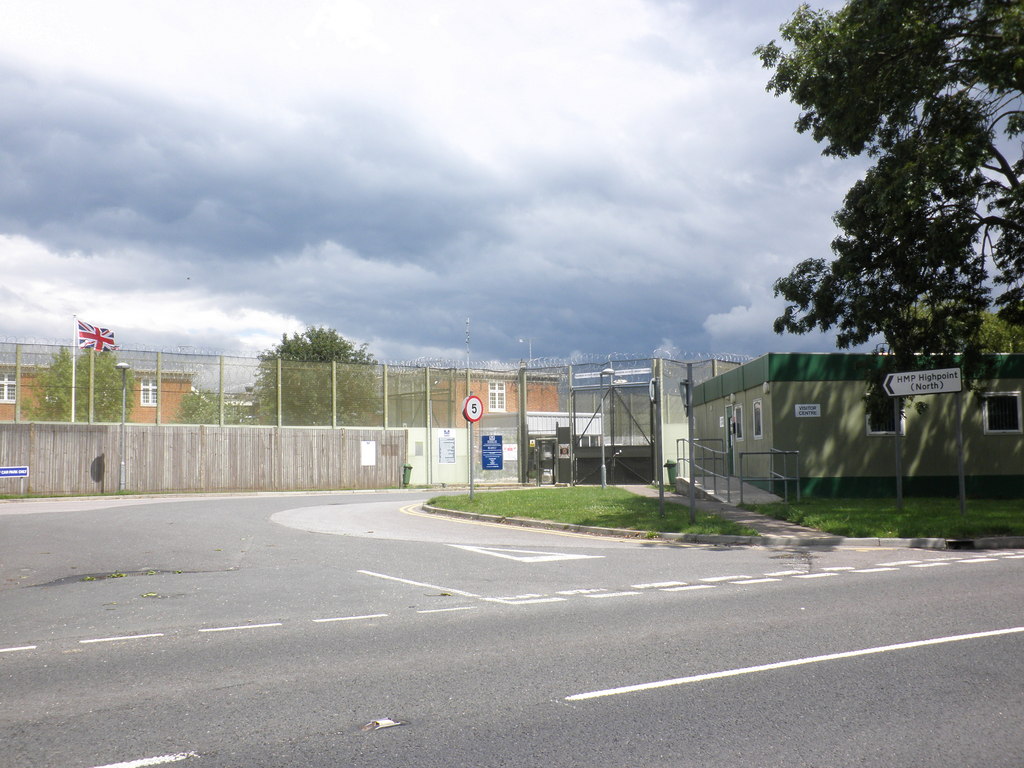
The prison sits on a former RAF base and opened in 1977. It occupies two adjacent sites divided by a main road. Most men held there had convictions linked to drugs or violence, and many lived a long way from home.
Our biggest concern, however, was that the prison was not fulfilling its core purpose.
Charlie Taylor, HM Chief Inspector of Prisons
Too little education and work
Men at Highpoint spent much more time out of their cells than prisoners at comparable jails. That time did not translate into enough purposeful activity. The report found too few activity places and not enough help for men seeking jobs on release.
Ofsted, which inspects education in prisons alongside the inspectorate, judged the overall effectiveness of provision inadequate. That is its lowest assessment. Inspectors said too much teaching in English and mathematics was of poor quality. Too few prisoners gained external qualifications.
Leaders had not put in place a reading strategy to improve literacy. Prisoners also lacked effective careers information, advice and guidance during their sentence.
The prison offered too little offending behaviour work, which aims to help people tackle the causes of their offending. Resettlement services also lacked coordination. The report concluded that Highpoint fell short of its stated aim as a training and resettlement prison.
Drugs and safety
Inspectors found that drugs and other illicit items were easy to obtain. The prison itself had identified a link between the drug supply and violence, debt and bullying. The report said it needed a more coherent and robust approach to the problem.
Leaders had taken several steps to cut supply and demand. They had also recruited a dedicated manager to drive a stronger strategy. Not all staff, however, actively supported this work or wider efforts to promote safety.
A considerable number of men were isolating themselves in their cells because they feared for their safety. According to the report, they received little support or encouragement to return to normal prison life.
Even so, the prison remained orderly and safe overall. Support in the early days of custody was reasonably good. Prisoners rated their treatment on arrival, and the cleanliness of first night cells, better than prisoners at similar jails.
Strong leadership, weak resettlement
Inspectors praised the stable, visible leadership. Leaders had focused on keeping standards high and getting the basics right. Charlie Taylor wrote: “we found a competent, well-led establishment that was orderly and safe.”
Relationships between staff and prisoners were a strength, and consultation with prisoners was good. Despite its ageing buildings, the prison kept the site in good repair. The health care team was well led and continued to meet patient need despite longstanding vacancies.
The report highlighted the prison’s approach to rewarding good behaviour as notable positive practice. Peer workers played an extensive role. Men could work towards places on enhanced and semi-open units. Weekly awards for the cleanest wing included extra gym sessions, exercise bicycles and cooking equipment.
Staffing had improved over the previous 12 months. Still, 20% of officers had been in post for less than a year, and many middle managers were new to their role. Far too few officers said they received regular supervision.
Preparation for release remained a weakness. Key work, in which an officer meets a prisoner regularly to offer support, fell short. Over the previous six months, the prison had delivered only a third of sessions. Offender management and public protection work also needed to improve, given the risk many men posed.
Support for foreign national prisoners was too limited. Staff rarely used professional telephone interpreting, and men had no access to free independent legal advice.
In 2019 the inspectorate had made 27 recommendations, nine of them about key concerns. By 2023 the prison had achieved two of those nine and partly achieved one. Six remained unmet. Overall, the Chief Inspector of Prisons described the visit as a reasonably good inspection. He said leaders had built a strong platform from which to improve outcomes, particularly the regime.
Later inspections
Inspectors have reported on Highpoint again since, with a full inspection published in October 2026. This article covers the report published in January 2024.
About this story
This story is based on HM Inspectorate of Prisons’ report on HMP Highpoint, published on 30 January 2024, following an inspection that ended in October 2023. It covers an earlier inspection: the prison’s profile has the latest findings. All figures and judgements are the inspectorate’s. Read the full inspection report · See the prison’s profile in our directory.