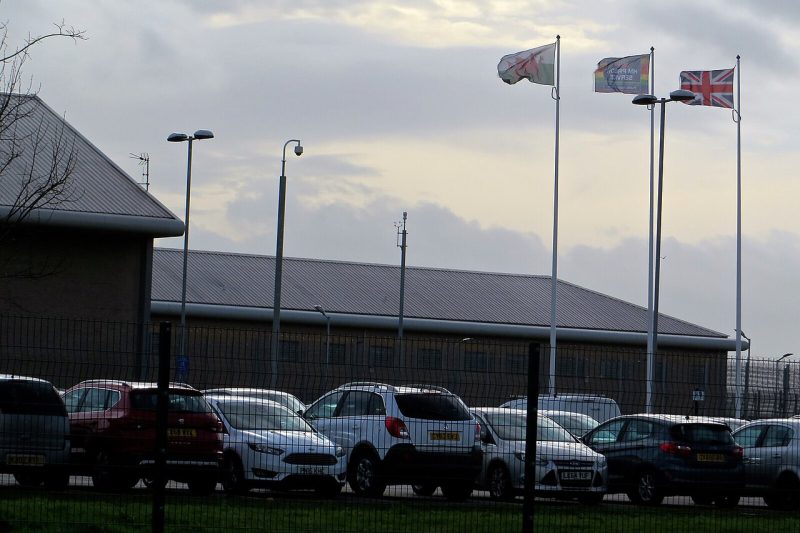
The Ministry of Justice (MoJ) has indicated that it would consider projectile launchers and some lasers as ways to stop drones flying drugs into prisons.
The department set out the range of acceptable options as it clarified the rules for a competition. The contest invites inventors to propose anti-drone systems to protect prisons in England and Wales.
The MoJ will take forward between two and six winning entries for development. It has set aside £1.85 million of public money for the scheme.
Officials want a ‘last line of defence’ for cases where a drone has already crossed a prison’s outer wall. At that stage, the drone may be heading for a cell window or an exercise yard to drop its load of contraband.
The goal goes beyond detection. The MoJ wants systems that stop drones, either by jamming their signals or by physically bringing them down.
Under the competition rules, a winning system must be lawful and safe for staff to use. It must pose minimal risk to bystanders and must not interfere with electronic systems that prison staff or the emergency services rely on.
The rules also rule out “explosive or kinetic effects that could damage buildings, vehicles, or utilities”.
The MoJ has prepared a list of frequently asked questions, with answers, to guide entrants. One asked whether the department would welcome kinetic or pneumatic systems that launch a projectile but are not traditional firearms.
The MoJ replied that inventors could propose such systems if they were low-collateral, legally compliant and safe in a custodial setting, and needed no firearms licence.
Another question asked about “hard kill” options, naming low-power lasers and high-power microwaves. The MoJ said any such option had to meet the standard of low collateral, safety and legal compliance. It warned that many high-energy systems raise safety and security problems in an operational setting.
A third question asked whether forcing a drone to turn back would count as success. The MoJ said it would treat any safe, low-collateral and lawful method that prevents delivery as a success. That could include sending a drone back to its starting point, a controlled landing or physically defeating it.